The Screening Gap: What the Numbers Tell Us
An estimated 80% of women in Ghana have never been screened for breast cancer. Among women of screening age specifically, 67.7% have never had a single clinical examination. These figures describe not a failure of individual choice but a structural gap, a healthcare landscape in which screening is inaccessible, rarely promoted, and culturally unfamiliar for most women.
The consequences show up in survival data. Over 4,000 new cases of breast cancer are diagnosed in Ghana each year, and approximately 70% of them are found at a late or terminal stage, when the disease is hardest and most expensive to treat. Breast cancer caught early, in Stage I or II, has a survival rate above 90%. Breast cancer caught late, in Stage III or IV, has a survival rate that drops sharply. The gap between those two numbers is the gap that screening closes.
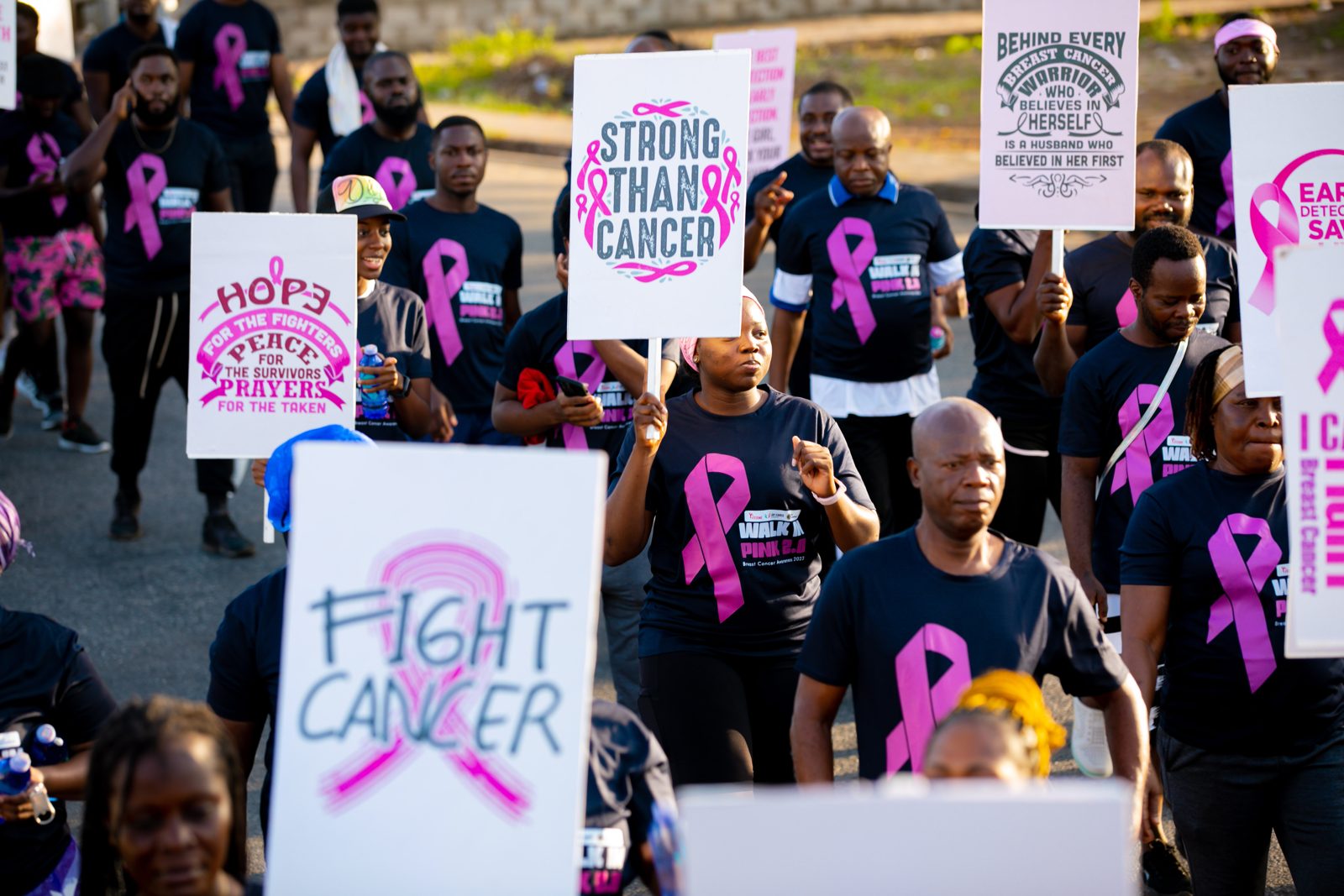
Why is the screening rate so low? The answers are layered. Physical access is the first barrier: mammography machines are concentrated in urban centres and private hospitals. For women in peri-urban communities or rural areas, the journey to a screening facility is long, expensive, and often impossible. Walk In Pink addresses this directly by bringing The Trust Hospital's clinical team into communities, taking the screening to the woman rather than asking her to travel.
Cost is the second barrier. Even where screening is available, it is rarely free. A clinical breast examination or mammogram carries a cost that many women in Ghana cannot absorb, particularly in communities where household income is precarious. The Sponsor-A-Mammogram model, launched at Walk In Pink 4.0, creates a direct link between community fundraising and free screenings. Every shirt purchased funds a screening for a woman who cannot afford one.
Awareness and fear are the third and fourth barriers, and they are intertwined. Many women do not know the signs of breast cancer, do not know what to look for in a self-examination, and have not been told that early detection dramatically improves outcomes. At the same time, some women who do suspect something is wrong avoid seeking help out of fear: fear of the result, fear of the medical system, fear of what knowledge might require them to do. The Survivor Chat, introduced at Walk In Pink 2.0 in Sakumono, directly addresses both. Hearing from women who faced breast cancer and lived, who were screened, treated, and are standing in front of you, transforms the conversation.
Cultural norms compound these barriers. Breast health is not widely discussed in many Ghanaian communities. Women may feel embarrassed to seek a clinical examination or reluctant to prioritise their own health over family obligations. The 31 Days of Pink campaign, school engagement programmes, and market screenings all work to shift these norms, normalising the conversation and making screening something neighbours talk about, teachers raise, and markets accommodate.
Walk In Pink has reached over 2,200 women with free screenings across four editions since 2022, in Teshie, Sakumono, Aglorkpovia in the Volta Region, and Nungua. At Walk In Pink 3.0 in Aglorkpovia, 20 suspected cases were identified and referred, among them one man. Most could not afford care and some had turned to shrines, so the disease had already spread when it was found. They are the human face of the screening gap, the people who move from the 80% who had never been checked to those with information, a referral, and a chance.
The goal for Walk In Pink 5.0 is 1,500 screenings in a single day. It is the most ambitious target the movement has set. But the screening gap is not closed by a single event or a single year. It is closed by sustained, community-level work, by making screening normal, accessible, and free for as many women as possible, for as many years as it takes. That is the work. Walk In Pink is one answer to it.